Feb 27, 2025 | Events

Durante l’inaugurazione della Stagione 2025 di attività di Fondazione Feltrinelli il 27 febbraio 2025 è stato presentato l’annale 2025 dedicato a «Democrazia al limite. Disinformazione e manipolazione dell’opinione pubblica nell’era digitale» curato da Giovanni Boccia Artieri che coinvolgerà studiose/i nazionali e internazionali a partire dai temi di ricerca sulla Fringe Democracy come materiale di disseminazione della ricerca CORIT.

Democrazia al limite Disinformazione e manipolazione dell’opinione pubblica nell’era digitale
Feb 20, 2025 | Events
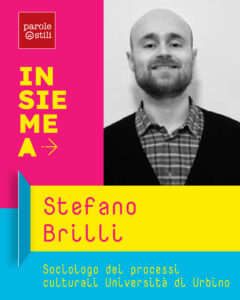
Nell’edizione 2025 del Festival di Parole O_Stili, terremo un workshop su polarizzazione e cultura digitale. È un modo di portare tra le persone il lavoro di ricerca su “Countering Online Radicalization and incivility in ITaly: from fringe to mainstream – CORIT”. È una prima restituzione pubblica del Glossario della polarizzazione frutto dell’analisi sulle fringe platform che si propone come strumento analitico per comprendere le pratiche polarizzanti nella Telegramsphere italiana. Queste dinamiche emergono in uno spazio comunicativo caratterizzato da anonimato, micro-pubblici coesi e affordance che potrebbe facilitare la radicalizzazione e la frammentazione sociale. L’obiettivo del glossario è:
- Offrire una tassonomia delle pratiche tossiche e polarizzanti osservabili.
- Contestualizzare questi fenomeni all’interno delle peculiarità di Telegram come piattaforma fringe.
- Fornire un riferimento teorico-pratico per futuri studi sulla polarizzazione digitale.
Ci aiuterà a discutere del tema, in un talk associato al workshop, il giornalista Stefano Arduini, direttore di Vita Magazine.
Sarà presentata una vera e propria guida pratica per esplorare le dinamiche delle pratiche tossiche nei contesti digitali. Scopriremo come generazioni diverse – dalla Gen Z ai Boomers – partecipano e reagiscono a queste pratiche, fornendo un glossario condiviso per interpretare un panorama comunicativo sempre più complesso e frammentato.




Ott 30, 2024 | Events
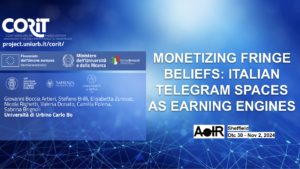 We participate at AoIR2024 «Industry» 30 October – 2 November 2024 • University of Sheffield (TUoS) and Sheffield Hallam University (SHU), Sheffield, UK with the paper: Monetizing fringe beliefs: italian telegram spaces as earning engines
MONETIZING FRINGE BELIEFS: ITALIAN TELEGRAM SPACES AS EARNING ENGINES
Introduction
The current digital landscape is characterized by a constellation of public, semi-public and private spaces (Boccia Artieri et al. 2021) connected by mutual migration dynamics. What is still unclear and under-researched, is the relationship between what may be defined as “fringe platforms” and the more mainstream web spaces as well as legacy media. The paper presented is a step of a broader research project (CORIT), funded by the Next Generation EU Program, concerning the development of narratives that are capable of “intoxicating” the Italian hybrid media system. While the goal of CORIT project is to understand Italian contemporary public spheres, analyzing the relation between fringe and mainstream media environments, this paper focuses on one aspect in particular: the monetization dynamics occurring in such fringe spaces.
Telegram as a fringe platform
According to de Winkel (2023), fringe platforms are described as alternative platform services created with the intention to critique the ideological foundations and practices of mainstream platform services. Furthermore, the author suggests fringe platforms should not be exclusively linked to extreme politics but encompass various technologies reflecting diverse ideologies. Fringe platforms, with a smaller user base, foster tighter ideological bonds, potentially exposing users to toxicity (Schulze et al. 2022) and spreading problematic content to mainstream media.
In this sense, Telegram is perceived as a fringe space due to its flexibility in distributing problematic content through semi-public channels, closed groups, and chats. To some extent, the platform appears to function as a conduit for disseminating information across various networks and platforms, thus amplifying the reach of its content. Indeed Telegram has positioned itself as optimal environment for individuals seeking privacy and security, characteristics that render it conducive to the exploration of information and contexts where conspiracy narratives grow (Schulze et al., 2022; Herasimenka et al., 2022). In particular, research conducted on Telegram has shown that within such spaces, alt-right conspiracist groups coordinate (Walther and McCoy 2021), and in general, disinformation spreads (Herasimenka et al. 2022). Although research on disinformation covers diverse topics such as media manipulation (Marwick and Lewis, 2017; van Dijck et al. 2023), an emerging area of study focuses on the digital platforms that enable the dissemination and monetization of disinformation.
Demonetization and affective support
Various forms of monetization, i.e. alternative monetization (Hua et al., 2022), introduce an additional financial incentive for content creation and have the potential to impact the growth of a channel. Considering how the value of online content is determined by its level of engagement due to its potential for monetization, platforms establish regulations that dictate the acceptability of content, which content can be taken down, and when content creators may be deplatformed (Rogers, 2020). While platforms set forth their own standards, certain viewers gravitate towards fringe channels, providing content creators with alternative norms for assessing and monetizing content in manners that deviate from the platform’s directives (Marwick et al. 2022). The act of demonetization strengthens the populist notion of anti-elitism, portraying the powerful as greedy and the commoners as financially deprived (Castanho Silva et al. 2017). Thus, mainstream platforms are seen as gatekeepers of financial gains while demonetized creators become those who are forced to free labor for their communities. This, then, resonates with what Eslen-Ziya (2019), defines as hybrid emotional echo-chambers as in such spaces this frustration due to inequality and lack of means is deeply intertwined with the collective identity of the group. Moreover, believing in misinformation activates emotional rather than cognitive dynamics (Sanchez & Dunning, 2021): in such spaces proximal viewpoints are presented with a positive emotional load, reinforcing negative feelings and hostility toward those referred to as out-groups. Therefore, the fusion of emotions with ideologies intensifies the dissemination of such content, but it also may play a key role in the financial support dynamics for producers, as it happens within politically mobilized extremist groups (Wade et al. 2023).
Research questions and methodology
Building on these premises, our study addresses a main research question and two sub-research questions:
R.Q.: Do fringe online communities, that define themselves in an anti-mainstream perspective, seek to differentiate themselves from the mainstream also through their monetization methods?
R.Q. 1: What monetization methods are present in these fringe communities?
R.Q. 2: Do these monetization methods become topics of discussion within the groups?
To approach these questions, we started from lists of Telegram channels/groups compiled by debunkers (Fletcher et al. 2018). From this initial list, we built a network of the main Italian Telegram channels and groups that disseminate problematic content through a snowballing method (Peeters & Willaert, 2022). Then, using a combination of ethnographic observation and scraping tools such as 4Cat and the Telethon Python library (Urman & Katz, 2020) we collected and analyzed 1) posts with news and corresponding comments, 2) any mention of monetization or funding, 3) any reference to content from the same group/channel on other platforms and media (i.e. YouTube videos, radio interviews etc.). The use of ethnographic observation played a crucial role in identifying the keywords for searching the content. It also helped to highlight the emic categories used by the group to legitimize various forms of monetization.
Preliminary results and expected outcomes
Although the ethnography and data collection on the selected groups and channels will continue until June 2024, we can already draw a number of substantive considerations. Firstly, it emerges how an understanding of terms such as “fringe” and “deplatforming” is necessary. While the existing literature has partly touched on the ambiguity of these concepts, there is a need to clarify the degree to which the referred groups are actually “peripheral” or “unseen”. The research has identified various interrelation dynamics between the analyzed spaces and the “mainstream” public sphere. These are some of the ways in which such interrelations happen:
- Technically: despite being more limited than other platforms, these spaces are affected by inbound and outbound cross-platform circulation of content.
- Economically: Various monetization methods we found seem to align with the platformization of mainstream cultural production (Poell et al., 2021) and present elements of aspirational labor practices (Duffy, 2016).
- By sourcing: these communities consistently import and comment sources from mainstream media, supporting the hypothesis that they form emotional rather informational echo-chambers (Eslen-Ziya et al., 2019) from framing these sources as “outgroup identifiers” (Törnberg & Törnberg, 2024), often using informational strategies such as sharing screenshots instead of the source links (Zurovac, 2023).
- Through cultural lexicon: lexicons and representations developed in these groups find resonance in highly visible media content as well as more visible public figures on television (journalists, “alternative” intellectuals, local and national politicians).
- Through visibility exchange: less conspicuous, fringe spaces cultivate subcultural fame, spawning “anti-mainstream” political experts and alternative lifestyles’ proponents. Contrary to what the terms “fringe” and “deplatforming” might suggest, some personalities accumulate a visibility capital that extends beyond Telegram.
Monetization strategies observed so far do not seem to mark a specific difference with the monetisation modalities prevalent within mainstream platforms and creators. Four main strategies emerged: 1) self-financing, group or individual asking for a voluntary donation to “keep the service alive”, 2) digital patronage, “premium” services such as special contents and consultancy, 3) the sale of products and merchandising, 4) “shady deals”, when the request for money is linked to the offer of investments whose returns are not transparent or guaranteed.
References
Boccia Artieri, G., Brilli, S., & Zurovac, E. (2021). Below the radar: Private groups, locked platforms, and ephemeral content—Introduction to the special issue. Social Media+ Society, 7(1).
Castanho Silva, B., Vegetti, F., & Littvay, L. (2017). The elite is up to something: Exploring the relation between populism and belief in conspiracy theories. Swiss Political Science Review, 23, 423–443.
Duffy, B. E. (2016). The romance of work: Gender and aspirational labour in the digital culture industries. International journal of cultural studies, 19(4), 441-457.
Eslen-Ziya, H., McGarry, A., Jenzen, O., Erhart, I., & Korkut, U. (2019). From anger to solidarity: The emotional echo-chamber of Gezi park protests. Emotion, Space and Society, 33, 100632.
Fletcher, R., Cornia, A., Graves, L., & Nielsen, R. K. (2018). Measuring the reach of” fake news” and online disinformation in Europe. Australasian Policing, 10(2).
Herasimenka, A. (2022). Movement leadership and messaging platforms in preemptive repressive settings: Telegram and the Navalny Movement in Russia. Social Media+ Society, 8(3).
Hua, Y., Horta Ribeiro, M., Ristenpart, T., West, R., & Naaman, M. (2022). Characterizing alternative monetization strategies on YouTube. Proceedings of the ACM on Human-Computer Interaction, 6(CSCW2), 1-30.
Marwick, A., Clancy, B., & Furl, K. (2022). Far-Right online radicalization: A review of the literature. The Bulletin of Technology & Public Life.
Peeters, S., & Willaert, T. (2022). Telegram and digital methods: Mapping networked conspiracy theories through platform affordances. M/C Journal, 25(1).
Poell, T., Nieborg, D. B., & Duffy, B. E. (2021). Platforms and cultural production. John Wiley & Sons.
Rogers, R. (2020). Deplatforming: Following extreme Internet celebrities to Telegram and alternative social media. European Journal of Communication, 35(3), 213-229.
Sanchez, C., & Dunning, D. (2021a). Cognitive and emotional correlates of belief in political misinformation: Who endorses partisan misbeliefs? Emotion.
Schulze, H., Hohner, J., Greipl, S., Girgnhuber, M., Desta, I., & Rieger, D. (2022). Far-right conspiracy groups on fringe platforms: a longitudinal analysis of radicalization dynamics on Telegram. Convergence: The International Journal of Research into New Media Technologies, 28(4), 1103-1126.
Törnberg, A., & Törnberg, P. (2024). Intimate Communities of Hate: Why Social Media Fuels Far-Right Extremism. Taylor & Francis.
Urman, A., Katz, S. (2022) What they do in the shadows: examining the far-right networks on Telegram, Information, Communication & Society, 25:7,904-923.
Wade, M., Baker, S. A., & Walsh, M. J. (2023). Crowdfunding platforms as conduits for ideological struggle and extremism: On the need for greater regulation and digital constitutionalism. Policy & Internet.
Walther, S., McCoy, A. (2021). US extremism on Telegram: Fueling disinformation. Conspiracy Theories, and Accelerationism. Perspectives on Terrorism, 15(2), 100–124.
de Winkel, T. (2023). Fringe platforms: An analysis of contesting alternatives to the mainstream social media platforms in a platformized public sphere (Doctoral dissertation, Utrecht University).
Zurovac, E. (2023). Screenshot society. Come le fotografie dello schermo raccontano il nostro stare online. FrancoAngeli.
Ott 17, 2024 | Events
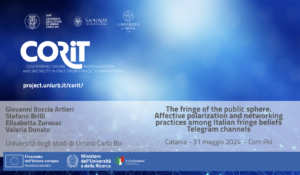 We participate at Convegno AssoComPol 2024 «The new European public sphere, the crises and challenges of “post truth”» Catania | Università di Catania | 30 May – 1 June 2024 with the paper: The fringe of the public sphere. Affective polarization and networking practices among Italian fringe beliefs Telegram channels
Abstract
The current landscape of digital platforms is characterized by a complex constellation of public, semi-public and private spaces. These spaces are heterogeneous in terms of visibility, regulation, and audiences, but also connected by mutual migration dynamics between fringe and mainstream environments that need to be studied in order to understand the contemporary communicative disorders.
According to de Winkel (2023), fringe platforms are described as alternative platform services created with the intention to critique the ideological foundations and practices of mainstream platform services. Furthermore, the author suggests fringe platforms should not be exclusively linked to extreme politics but encompass various technologies reflecting diverse ideologies. Fringe platforms, with a smaller user base, foster tighter ideological bonds, potentially exposing users to toxicity (Schulze et al. 2022) and spreading problematic content to mainstream media. In this sense, Telegram is perceived as a fringe space due to its flexibility in distributing problematic content through semi-public channels, closed groups, and chats. To some extent, the platform appears to function as a conduit for disseminating information across various networks and platforms, thus amplifying the reach of its content.
Since its creation in 2013, Telegram has positioned itself as an ideal space for those who yearn for privacy and security, an affordance that satisfies those who dream of a free internet, and for those who find themselves compelled to use such a space as the only safe way to coordinate (Urman and Katz 2022). Telegram from this point of view seems to be the ideal place to trace information and contexts in which conspiracy narratives are found to flourish (Schulze et al. 2022, Herasimenka et al. 2023). In particular, the function of Telegram channels has been rapidly adopted for news broadcasting (Wijermars 2022). Moreover, research conducted on Telegram has shown that, in spaces such as these, extreme fringes recruit users (Urman & Katz 2022); alt-right conspiracist groups coordinate (Walther and McCoy 2021), and in general, disinformation spreads (Herasimenka et al. 2023). What is still unclear and under-researched, is the relationship between what may be defined as “fringe platforms” and the more mainstream web spaces as well as legacy media. In other words, it is necessary to understand how the practices and languages developed in fringe platforms move outside of them, i.e. between upstream and downstream (Woolley 2022). In this regard, understanding this dynamic can be deemed necessary where the characteristics of today’s platformized public sphere are acknowledged. Indeed, studying Telegram entails investigating not only its peculiarities and technological infrastructure but rather its ideological and social ecosystem.
As part of an ongoing project (CORIT), funded by the National Recovery and Resilience Plan (NRRP) and concerning the development of narratives that are capable of “intoxicating” the Italian hybrid media system, this paper aims to answer two different research questions:
RQ1: how do practices and discourses of toxicity develop within fringe beliefs Telegram channels in Italy?
RQ2: whether and how these toxicity impact on the Italian public sphere?
To do so, starting from lists of Telegram channels/groups compiled by debunkers (i.e. list from BUTAC https://www.butac.it/the-black-list/) (Fletcher et al. 2017), it has been built a network of the main Italian Telegram channels and groups that disseminate problematic content through a snowballing method (Peeters & Willaert, 2022). Then, using a combination of ethnographic observation and scraping tools such as 4Cat and the Telethon Python library (Urman & Katz, 2020) we collected and analyzed 1) news posted and their comments, 2) the most frequent themes framed, 3) recurrent lexicons participating in affective polarization, which has been clustered through the Emotional Text Mining technique (Boccia Artieri et al. 2021). Results will focus on the representations and practices related to affective polarization in Telegram radicalized channels/groups as well as to provide an insight of the Telegram public sphere and its adherence/discrepancy with the Italian public sphere. Therefore, analysing Telegram as a fringe platform provides a new opportunity not only to understand its public debate, but also to recognize the influence of mainstream platforms themselves in shaping the interrelated public agenda and sphere (Bentivegna & Boccia Artieri 2020). Considering the online public sphere as an ecosystem of forces, analyzing the specificity of Telegram allows reflecting on the central themes of online democratic participation (Davis, 2021): the quality and/or toxicity of discourse, the balancing of information priorities, as well as the broader consequences of platformization in the developments of the Italian public sphere.
References
Bentivegna, S., & Boccia Artieri, G. (2020). Rethinking public agenda in a time of high-choice media environment. Media and Communication, 8(4), 6-15.
Boccia Artieri, G., Brilli, S., & Zurovac, E. (2021). Below the radar: Private groups, locked platforms, and ephemeral content—Introduction to the special issue. Social Media+ Society, 7(1).
Davis, M. (2021). The online anti-public sphere. European Journal of Cultural Studies, 24(1), 143-159.
de Winkel, T. (2023). Fringe platforms: An analysis of contesting alternatives to the mainstream social media platforms in a platformized public sphere (Doctoral dissertation, Utrecht University).
Fletcher, R., Cornia, A., Graves, L., & Nielsen, R. K. (2018). Measuring the reach of” fake news” and online disinformation in Europe. Australasian Policing, 10(2).
Herasimenka, A., Bright, J., Knuutila, A., & Howard, P. N. (2023). Misinformation and professional news on largely unmoderated platforms: The case of telegram. Journal of Information Technology & Politics, 20(2), 198-212.
Hua, Y., Horta Ribeiro, M., Ristenpart, T., West, R., & Naaman, M. (2022). Characterizing alternative monetization strategies on YouTube. Proceedings of the ACM on Human-Computer Interaction, 6(CSCW2), 1-30.
Peeters, S., & Willaert, T. (2022). Telegram and digital methods: Mapping networked conspiracy theories through platform affordances. M/C Journal, 25(1).
Schulze, H., Hohner, J., Greipl, S., Girgnhuber, M., Desta, I., & Rieger, D. (2022). Far-right conspiracy groups on fringe platforms: a longitudinal analysis of radicalization dynamics on Telegram. Convergence: The International Journal of Research into New Media Technologies, 28(4), 1103-1126.
Urman, A., Katz, S. (2022) What they do in the shadows: examining the far-right networks on Telegram, Information, Communication & Society, 25:7,904-923.
Walther, S., McCoy, A. (2021). US extremism on Telegram: Fueling disinformation. Conspiracy Theories, and Accelerationism. Perspectives on Terrorism, 15(2), 100–124.
Wijermars, M. (2022). Selling internet control: the framing of the Russian ban of messaging app Telegram. Information, Communication & Society, 25(15), 2190-2206.
Woolley, S. C. (2022). Digital propaganda: The power of influencers. Journal of Democracy, 33(3), 115-129.
Set 24, 2024 | Events
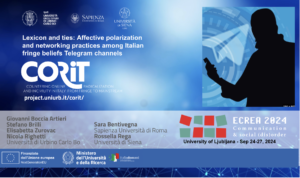 We participate at ECREA 2024 «Communication & social (dis)order» 10th European Communication Conference – University of Ljubljana
Faculty of Social Sciences – 24 – 27 September 2024 Slovenia with the paper: Lexicon and ties: affective polarization and networking practices among Italian fringe beliefs Telegram channels
Lexicon and ties: affective polarization and networking practices among Italian fringe beliefs Telegram channels
The current landscape of digital platforms is characterized by a complex constellation of public, semi-public and private spaces. These spaces are heterogeneous in terms of visibility, regulation and audiences, but also connected by mutual migration dynamics between fringe and mainstream environments that need to be studied in order to understand the contemporary communicative disorders.
Since its creation in 2013, Telegram has positioned itself as an ideal space for those who yearn for privacy and security, an affordance that satisfies those who dream of a free internet, and for those who find themselves compelled to use such a space as the only safe way to coordinate (Urman and Katz 2022). Telegram from this point of view seems to be the ideal place to trace information and contexts in which conspiracy narratives are found to flourish (Schulze et al. 2022, Herasimenka et al. 2022). In particular, the function of Telegram channels has been rapidly adopted for news broadcasting (Wijermars 2021). Moreover, research conducted on Telegram has shown that, in spaces such as these, extreme fringes recruit users (Urman & Katz 2022); alt-right conspiracist groups coordinate (Walther and McCoy 2021), and in general, disinformation spreads (Herasimenka et al. 2022). What is still unclear and under-researched, is the relationship between such fringe platforms and the more visible and mainstream web spaces as well as legacy media. In other words, it is necessary to understand how the practices and languages developed in fringe platforms move outside of them, i.e. between upstream and downstream (Gursky et al. 2022). As part of an ongoing project (CORIT), funded by the National Recovery and Resilience Plan (NRRP) and concerning the development of narratives that are capable of “intoxicating” the Italian hybrid media system, this paper aims to answer therq RQ1: how do practices and discourses of toxicity develop within fringe beliefs Telegram channels in Italy?
To do so, starting from lists of Telegram channels/groups compiled by debunkers (i.e. list from BUTAC https://www.butac.it/the-black-list/) (Fletcher et al. 2017), it has been built a network of the main Italian Telegram channels and groups that disseminate problematic content through a snowballing method (Peeters & Willaert, 2022). Then, using a combination of ethnographic observation and scraping tools such as 4Cat and the Telethon Python library (Urman & Katz, 2020) we collected and analyzed 1) news posted and their comments, 2) the most frequent targets of hostility, 3) recurrent lexicons participating in affective polarization, which has been clustered through the Emotional Text Mining technique (Boccia Artieri et al. 2021). Results will focus on the vocabularies, representations, and practices related to affective polarization in Telegram radicalized channels/groups, to provide a “Polarisation Glossary” useful for avoiding counter-measures that may lead to an escalation of distrust, uncivilty, and radicalization.
Set 12, 2024 | Events

Abbiamo partecipato al Convegno SISP 2024 – Università di Trieste – 12 al 14 Settembre 2024 con il paper: L’inciviltà ai margini: l’impatto delle piattaforme fringe sul dibattito pubblico
L’inciviltà ai margini: l’impatto delle piattaforme fringe sul dibattito pubblico.
Il panorama contemporaneo della comunicazione digitale è caratterizzato da un complesso intreccio di spazi pubblici, semi-pubblici e privati (Boccia Artieri, Brilli, Zurovac 2021). Questi spazi differiscono per visibilità, regolamentazione e partecipazione, ma sono interconnessi attraverso dinamiche di migrazione reciproca tra ambienti “ai margini” e realtà mediali mainstream. Comprendere queste dinamiche è essenziale per indagare l’ipotesi di deterioramento del dibattito pubblico a causa di un aumento della tossicità dalla dimensione discorsiva.
Questo processo sembra rafforzato dalla partecipazione dei cittadini a piattaforme online alternative o “fringe” (de Winkel, 2023). In particolare, Schulze e colleghi (2022) hanno analizzato come questi spazi – allo stesso tempo tecnici, culturali e sociali – siano collegati a ecosistemi di disinformazione, alla diffusione di narrazioni e ideologie cospirazioniste, e alla normalizzazione del pensiero populista ed estremista. Gli autori sottolineano l’esistenza di una relazione di co-dipendenza e interdipendenza tra l’aumento di spazi online alternativi e la crescita di forme discorsive associate all’estrema destra.
Benché questi ambienti online marginali possano essere interpretati come laboratori per lo sviluppo di punti di vista problematici capaci di penetrare nel mainstream, al contempo possono dare voce a comunità emarginate e svantaggiate, tanto da proporsi anche come nuove risorse per il dibattito pubblico contemporaneo.
Il presente lavoro illustra i presupposti teorici e le proposte metodologiche del progetto di ricerca “Countering Online Radicalization and Incivility in Italy: from Fringe to Mainstream” (CORIT), finanziato dal Programma Next Generation EU. Il progetto si focalizza sull’analisi di narrazioni, gruppi e azioni marginali strutturate con l’intento di “intossicare” il sistema dei media ibrido italiano. CORIT si propone di delineare le basi concettuali, empiriche ed etiche nello studio della Telegramsphere italiana, oltre a valutare la sua possibile influenza e interdipendenza con le piattaforme di discussione mainstream.
Telegram, difatti, si è posizionato, sin dalla sua creazione, come uno degli spazi privilegiati per tutti gli utenti in cerca di privacy, libertà discorsiva e sicurezza, caratteristiche capaci di attrarre tanto coloro che immaginano una rete libera quanto gli utenti costretti a utilizzare tale spazio come l’unico mezzo sicuro di coordinamento (Urman e Katz 2022). Telegram, d’altro canto, appare essere un ambiente ideale per monitorare informazioni e contesti in cui le narrazioni problematiche e complottistiche tendono a prosperare (Schulze et al. 2022, Herasimenka et al. 2022). In particolare, i canali Telegram sono rapidamente diventati popolari per la trasmissione di notizie alternative (Wijermars 2021), il reclutamento di gruppi estremisti (Urman & Katz 2022), il coordinamento di gruppi complottisti di estrema destra (Walther e McCoy 2021) nonché la diffusione di disinformazione (Herasimenka et al. 2022).
Tuttavia, ciò che rimane poco chiaro e non sufficientemente esplorato è la relazione tra tali spazi e culture marginali su Telegram e gli spazi web più visibili e popolari, così come la loro risonanza sui media tradizionali. In altre parole, diviene cruciale comprendere come pratiche e linguaggi sviluppati in piattaforme marginali possano estendersi oltre ad esse, navigando tra dinamiche a monte e a valle (Jost et al. 20223).
Il lavoro che proponiamo, dunque, si basa su una scoping review e una valutazione critica delle risorse accademiche raccolte attraverso Scopus, Google Scholar e Web of Science sui termini chiave del progetto “fringe platform/social media/online spaces” e “deplatforming”. Espandendo, inoltre, tale rassegna la presentazione si propone due obiettivi principali. In primis, esplorare come la letteratura accademica costruisca il concetto di piattaforme, pratiche e spazi online “fringe”, al fine di analizzare criticamente come l’imperativo di caratterizzare comportamenti potenzialmente pericolosi debba confrontarsi con il rischio di contribuire all’emarginazione di tali gruppi. In secondo luogo, approfondire, in chiave concettuale e metodologica, che tipo di pratiche e categorie di analisi possano emergere in questo peculiar campo di studio, ancora oggi accademicamente considerate come “below the radar” (Boccia Artieri et al. 2021).
Studiare, dunque, l’ecosistema mediale nella sua complessità e completezza può consentire di valutare le evoluzioni della piattaformizzazione della politica e dell’agenda pubblica nonché le modalità con cui queste influiscono sulla comunicazione politica, culturale e sociale.
References
Boccia Artieri, G., Brilli, S., & Zurovac, E. (2021). Below the radar: Private groups, locked platforms, and ephemeral content—Introduction to the special issue. Social Media+ Society, 7(1).
Castanho Silva, B., Vegetti, F., & Littvay, L. (2017). The elite is up to something: Exploring the relation between populism and belief in conspiracy theories. Swiss Political Science Review, 23, 423–443.
Herasimenka, A. (2022). Movement leadership and messaging platforms in preemptive repressive settings: Telegram and the Navalny Movement in Russia. Social Media+ Society, 8(3).
Jost, P., Heft, A., Buehling, K., Zehring, M., Schulze, H., Bitzmann, H., & Domahidi, E. (2023). Mapping a Dark Space: Challenges in Sampling and Classifying Non-Institutionalized Actors on Telegram. M&K Medien & Kommunikationswissenschaft, 71(3-4), 212-229.
Marwick, A., Clancy, B., & Furl, K. (2022). Far-Right online radicalization: A review of the literature. The Bulletin of Technology & Public Life.
Peeters, S., & Willaert, T. (2022). Telegram and digital methods: Mapping networked conspiracy theories through platform affordances. M/C Journal, 25(1).
Poell, T., Nieborg, D. B., & Duffy, B. E. (2021). Platforms and cultural production. John Wiley & Sons.
Rogers, R. (2020). Deplatforming: Following extreme Internet celebrities to Telegram and alternative social media. European Journal of Communication, 35(3), 213-229.
Sanchez, C., & Dunning, D. (2021a). Cognitive and emotional correlates of belief in political misinformation: Who endorses partisan misbeliefs? Emotion.
Schulze, H., Hohner, J., Greipl, S., Girgnhuber, M., Desta, I., & Rieger, D. (2022). Far-right conspiracy groups on fringe platforms: a longitudinal analysis of radicalization dynamics on Telegram. Convergence: The International Journal of Research into New Media Technologies, 28(4), 1103-1126.
Törnberg, A., & Törnberg, P. (2024). Intimate Communities of Hate: Why Social Media Fuels Far-Right Extremism. Taylor & Francis.
Urman, A., Katz, S. (2022) What they do in the shadows: examining the far-right networks on Telegram, Information, Communication & Society, 25:7,904-923.
Walther, S., McCoy, A. (2021). US extremism on Telegram: Fueling disinformation. Conspiracy Theories, and Accelerationism. Perspectives on Terrorism, 15(2), 100–124.
Wijermars, M. (2021). Russia’s law ‘On news aggregators’: Control the news feed, control the news?. Journalism, 22(12), 2938-2954.
de Winkel, T. (2023). Fringe platforms: An analysis of contesting alternatives to the mainstream social media platforms in a platformized public sphere (Doctoral dissertation, Utrecht University)

Commenti recenti