
Selected Papers of #AoIR2025:
The 26th Annual Conference of the
Association of Internet Researchers
Niterói, Brazil / 15 – 18 Oct 2025
FRAGMENTED FLOWS: ALGORITHMIC CURATION, ORGANIC SHARING, AND THE STRUCTURING OF TELEGRAM’S FRINGE COMMUNITIES
Introduction
How does Telegram’s algorithmic curation compare to organic content flows, and what drives information circulation within its fringe communities?
The digital era’s fragmentation of the public sphere, shaped by algorithmic curation rather than traditional editorial oversight, has redefined how information circulates, and communities form online (Caplan & boyd, 2016; Boccia Artieri & Donato, 2024). Rather than a single, unified space for public debate, contemporary digital platforms foster multiple, self-sustaining sub-spheres (Bentivegna & Boccia Artieri,2020), where content visibility is structured by algorithmic processes (Bruns, 2023) and homophily (McPherson, 2001).
Within this landscape, Telegram has emerged as a central platform for alternative narratives, benefiting from its minimal moderation policies and encryption features that facilitate the formation of ideologically homogeneous communities (Urman & Katz, 2022; Buehling & Heft, 2023).
In Italy, as elsewhere, these dynamics are further intensified by declining trust in traditional media and the increasing role of digital platforms in structuring public debate (Lovari, 2020). Telegram has become a key hub for counter-narratives and alternative news sources, often attracting communities excluded from mainstream discourse (Monaci & Persico, 2023). This fragmented digital ecosystem raises essential questions about the relationship between algorithmic recommendations and organic content circulation in shaping online discourse.
The extent to which Telegram’s recommendation system structures information flows differently from organic sharing mechanisms remains an open question. While algorithmic curation suggests channels based on audience or topic overlap, organic interactions—such as forwarding and link-sharing—may reflect different logics of content dissemination, potentially fostering alternative network structures (Simon et al., 2020).
Against this backdrop, this study, part of the broader project Corit, investigates the following research questions:
RQ1) Is there any structural homology between the similar-channel network and the networks formed through organic content-sharing behaviors (forwarding, link-sharing, and domain-sharing)?
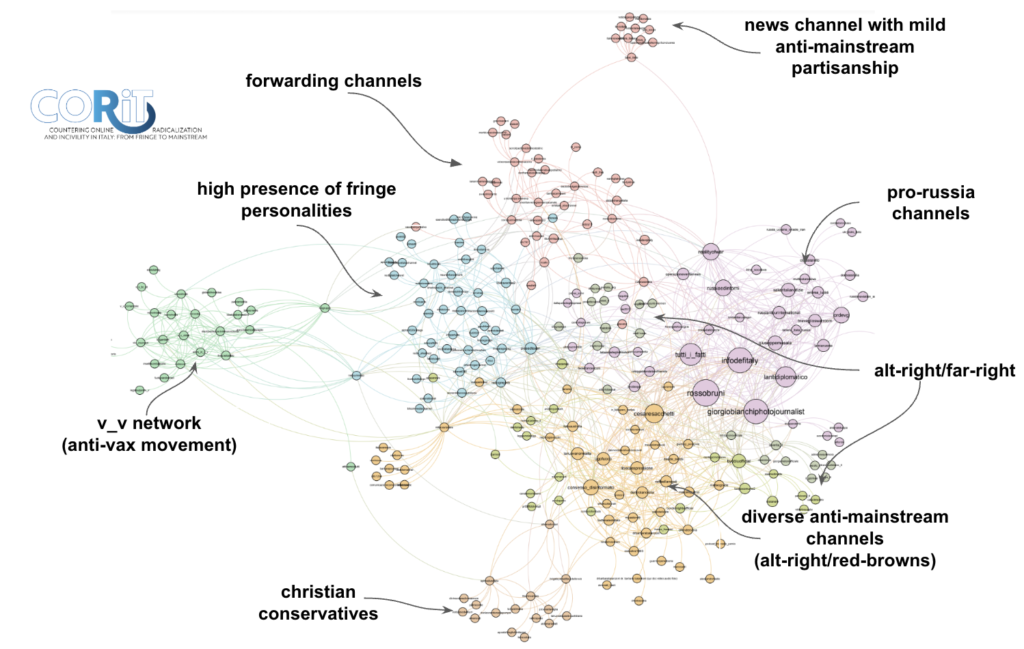
In the second phase, three network structures were generated from the channels identified via Telegram’s recommendation algorithm, with data collected through focused API queries. The first analyzed forwarded messages to detect user clusters formed through organic interactions. The second examined shared URL domains to identify channels referencing similar sources, while the third mapped shared links. Monopartite projections of bipartite networks were used to construct these networks. Data collection spanned August 30, 2021, to August 29, 2024, a period of heightened Telegram-related media activity identified via MediaCloud. The final dataset included 190,970 messages from 531 channels (covering 93% of our list), comprising 37,177 forwarded messages, 4,176 unique URL domains, and 51,639 shared links from 472 channels.
We integrated the four networks into a multiplex structure, linking channels through multiple relationship types across distinct layers (Dickison et al., 2016). Using the R library “multinet” (Magnani et al., 2021), we analyzed network density, clustering, and average path length, measuring channel overlap with Jaccard actor similarity. Generalized Louvain modularity optimization identified communities and compared them using the Adjusted Rand Index (ARI) to assess clustering consistency. ARI values range from -1 to 1, where values near 1 indicate similar clustering.
Result
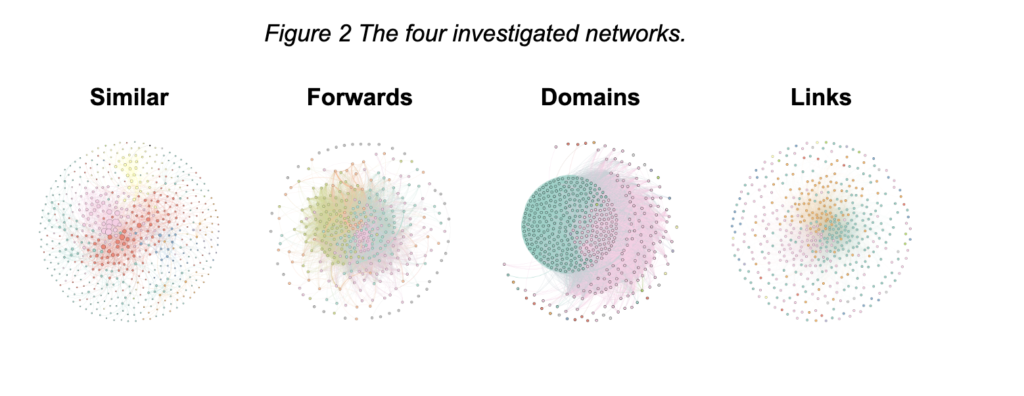
Analyzing network density (dens), clustering coefficient (cc), and average path length (apl), we identified structural differences across the networks. The similar-channel network is sparse and diffuse (dens: 0.01, cc: 0.28, apl: 4.05), while the domain network is dense and tightly clustered (dens: 0.61, cc: 0.89, apl: 1.76). The link network is more complex, with moderate connectivity (dens: 0.10, cc: 0.46, apl: 2.93). The forward network shows moderate density and clustering (dens: 0.27, cc: 0.66, apl: 2.12). The weak correlation between similar channels and those forwarding messages (Jaccard similarity: 0.12) suggests that forwarded messages mostly come from external sources rather than algorithmically recommended similar channels.
Figure 2 The four investigated networks.
The dense, highly clustered URL-domain network shows most channels rely on a set of common sources. The domain-domain projection (Figure 3) reveals strong interconnections, minimal clustering, and widespread cross-channel overlap, reflected in its low modularity (0.24). The visualization highlights the centrality of mainstream sources (Adnkronos, Ansa), cross-partisan newspapers (Il Messaggero, Il Tempo), conservative outlets (Il Giornale, Libero Quotidiano), and cross-platform sharing (YouTube, Facebook, Twitter).
Figure 3. Network of URL domains and links (projected via co-sharing channels), with node size proportional to sharing frequency.
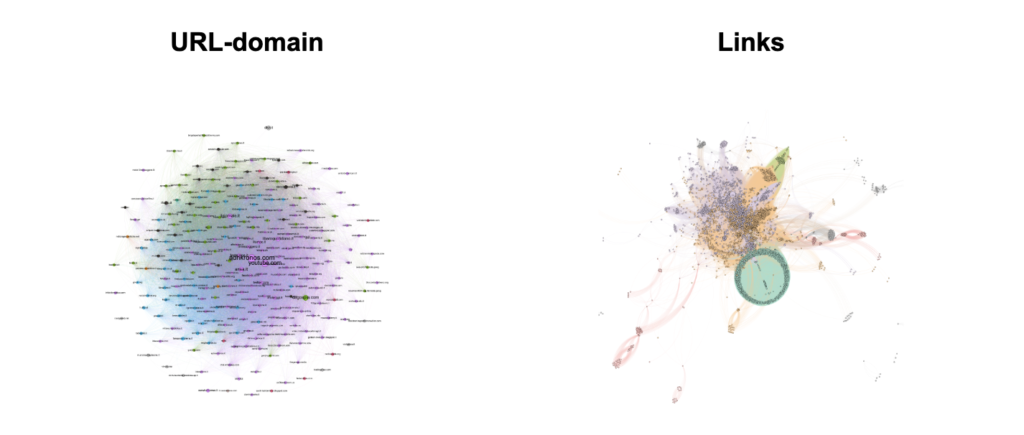
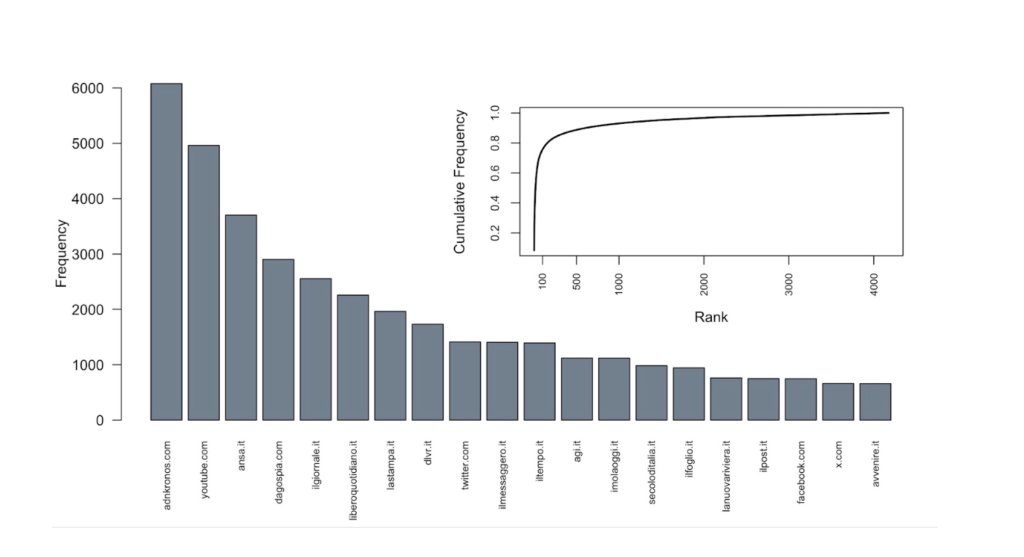
This indicates that most Telegram accounts, regardless of their thematic community, rely on similar information sources, with mainstream media being the most shared (Figure 4). However, the link-sharing network presents a more diversified structure, reflected in its higher modularity (0.88), suggesting that while channels use common sources, they still selectively share different content.
Figure 4. Distribution of the top 20 domains by frequency. Cumulative frequency indicates that a few domains account for the majority of shares.
Clustering comparisons across networks using the Adjusted Rand Index (ARI) confirm the picture. Audience overlap in the similar-channel network is weakly reflected in domain sharing (ARI=0.14) and forwarding (0.20). The link-sharing network aligns better with audience structure (0.53) but still shows discrepancies, indicating distinct dynamics.
Conclusion
Our findings show weak structural overlap between Telegram’s algorithmic recommendations and organic content-sharing networks. The similar-channel network is diffuse and shaped by audience overlap, while the domain-sharing network is dense and clustered around common sources. The forwarding network integrates external channels, and the link-sharing network reflects internal community dynamics with distinct content-sharing patterns. Despite their differences, fringe communities partly rely on common sources, including mainstream media, while shared links and forwarded messages highlight specific content preferences. These results call for further investigation into shared content and sources, while underlying the value of a multiplex approach in analyzing the interplay between algorithmic curation and organic sharing. The implications for online discourse in the digital sphere will be discussed.
Commenti recenti